Cascade County Dog Registration Information
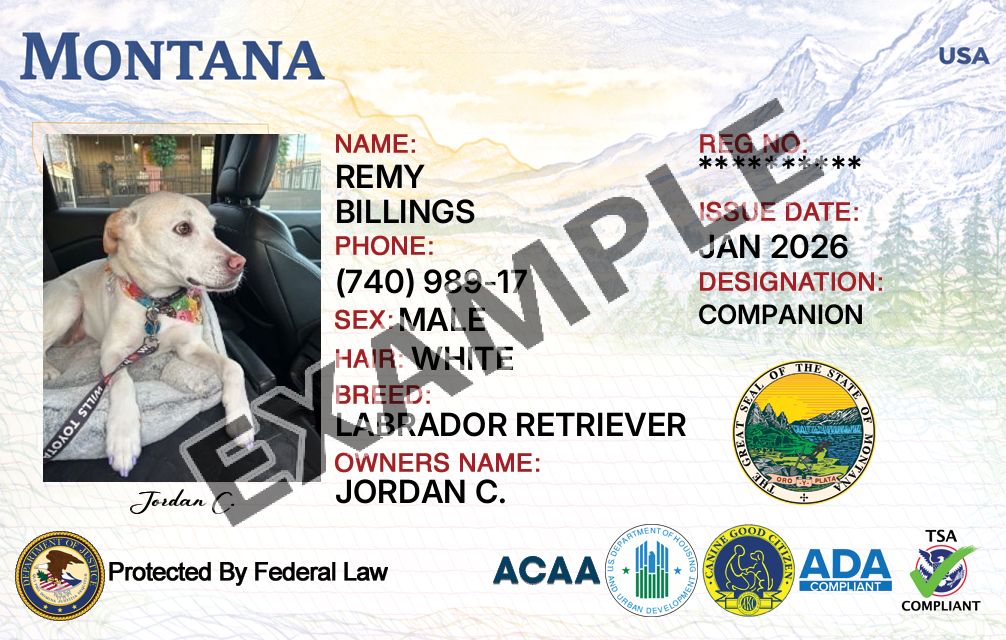
Service Dogs and Emotional Support Animals in Cascade, Montana
If you’re asking, “where do I register my dog in Cascade County, Montana for my service dog or emotional support dog?” the key is to separate two things: (1) your local dog license in Cascade County, Montana (which may be required by a city or municipality), and (2) your dog’s service dog or emotional support animal (ESA) status under state and federal rules. There is no single universal federal government registry for service dogs or emotional support animals; instead, local registration typically means a city pet license or local animal control registration tied to rabies vaccination records.
Where to Register or License Your Dog in Cascade County, Montana
The offices below are the primary official contacts found for pet registration/licensing and animal control coverage that serves residents in Cascade County, Montana. If you are unsure which office applies to your address, call the closest official office first and ask whether your residence is within city limits or in an unincorporated area.
City of Great Falls Animal Shelter (Pet Registration / Licensing)
- Monday: 12:00 PM – 4:30 PM
- Tuesday: 12:00 PM – 4:30 PM
- Wednesday: 12:00 PM – 4:30 PM
- Thursday: 2:00 PM – 4:00 PM
- Friday: 12:00 PM – 4:30 PM
- Saturday: 10:00 AM – 2:00 PM
- Sunday: Closed
Cascade County Sheriff’s Office (Rural / Unincorporated Animal Control Contact)
Overview of Dog Licensing in Cascade County, Montana
Why licensing exists (and why it still matters for service dogs and ESAs)
A local dog license (sometimes called pet registration) is usually a city or municipal requirement intended to connect a dog to an owner’s contact information and confirm basic public health requirements (most commonly rabies vaccination). If your dog is a service dog or an emotional support animal, you may still be required to follow the same local rules for licensing or registration that apply to other dogs in your area.
City vs. county: what can differ within Cascade County
In Cascade County, requirements can differ by jurisdiction:
- Inside Great Falls city limits: The City of Great Falls requires pet registration for dogs and cats over a specified age threshold and ties registration to rabies vaccination documentation.
- Outside city limits (unincorporated areas): The county has a dog control ordinance related to dogs at large and impoundment. Rural animal control responsibilities are handled through the Cascade County Sheriff’s Office. Licensing requirements may not mirror Great Falls city registration rules, so residents should confirm what applies to their exact address.
- Other incorporated cities/towns in the county: Some municipalities may require licensing through a city office. If you’re within another city’s limits, verify that city’s licensing instructions directly.
What You Need Before Registering a Dog
Common documentation and information
Local dog licensing requirements in Cascade County, Montana (especially within city limits) commonly focus on proof that your dog is vaccinated and identifiable. You may be asked for:
- Proof of current rabies vaccination (often a rabies certificate from a licensed veterinarian)
- Your identification (such as a driver’s license or other photo ID)
- Proof of address (especially if city-limit residency matters)
- Spay/neuter documentation (if fees differ by altered status)
- Dog details (name, approximate age, breed, color/markings, and sex)
- Payment method for any applicable license/registration fee
Rabies vaccination is often the “gatekeeper” item
Many jurisdictions will not issue a license without verified proof of rabies vaccination. If you recently vaccinated your dog, keep the paperwork from the veterinarian available when you register.
Steps to Register or License a Dog in Cascade County, Montana
Step 1: Confirm your jurisdiction (city limits vs. unincorporated area)
Start by confirming whether you live within:
- Great Falls city limits (generally handled through the City of Great Falls Animal Shelter for pet registration)
- Unincorporated Cascade County (animal control concerns handled through the Cascade County Sheriff’s Office; licensing requirements may differ)
- Another municipality within the county (may have a city office managing dog licenses)
Step 2: Gather the required documents
Before you call or go in, collect your rabies certificate and basic owner/dog details. If your dog is spayed or neutered and that affects fees, bring the documentation if you have it.
Step 3: Register/license through the correct office
- Great Falls residents: Contact the City of Great Falls Animal Shelter for pet registration instructions and required documentation.
- Rural/unincorporated residents: Contact the Cascade County Sheriff’s Office to confirm what local rules apply to your area and where any required licensing/registration is processed.
Step 4: Keep your records current
Licenses typically expire and must be renewed. Rabies vaccinations also expire and must be kept current. Keeping the tag and/or proof of licensing with your dog (as required locally) helps if your dog becomes lost.
Service Dog Laws in Cascade County, Montana
No universal “service dog registration” through the federal government
Service dogs in the U.S. are defined by function and training (performing tasks for a person with a disability) rather than by being listed in a single national database. You may see references online to registries, certificates, or IDs, but these are not the same as the legal definition of a service dog under applicable disability law.
Local licensing vs. service dog status
Even if your dog is a service dog, local jurisdictions may still require a standard dog license. In Great Falls, the city indicates that service animals must be licensed; local fee rules may vary. Practically, that means:
- Service dog status relates to disability accommodation and access rules.
- Dog licensing requirements in Cascade County, Montana (and in your city) relate to public health and local animal ordinances.
- Your service dog may need both: legal service dog status and a local pet license/registration.
What a licensing office may request (and what they may not)
A licensing office commonly asks for rabies vaccination proof and owner contact information. Service dog status does not replace rabies vaccination requirements or local licensing rules. If you have questions about documentation for fee waivers (if offered locally), ask the licensing office directly what they require.
Emotional Support Animal Rules in Cascade County, Montana
ESAs are different from service dogs
An emotional support animal (ESA) generally provides comfort by its presence. Unlike a service dog, an ESA is not defined by being trained to perform specific tasks related to a disability in the same way. Because of that, ESA status typically does not grant the same public access rights as service dogs.
Licensing is still a local requirement
If your dog is an ESA, you should still plan to follow the normal licensing pathway for your jurisdiction:
- If you live in Great Falls: follow city pet registration rules through the Great Falls Animal Shelter.
- If you live outside Great Falls city limits: confirm requirements and procedures for your area through the Cascade County Sheriff’s Office and/or your local municipality.
ESA letters vs. “registration”
ESA documentation is commonly discussed in housing contexts; however, it is not the same thing as a local dog license. A city or county licensing office generally focuses on vaccination status and owner contact details rather than ESA documentation.
Dog License vs. Service Dog vs. Emotional Support Animal (Comparison)
| Category | Dog License / Pet Registration | Service Dog | Emotional Support Animal (ESA) |
|---|---|---|---|
| What it is | Local registration/licensing required by a city/municipality (and sometimes other jurisdictions), typically tied to rabies vaccination and owner contact info. | A dog trained to perform tasks for a person with a disability (status defined by function/training, not by a universal registry). | An animal that provides emotional support/comfort by presence; generally not task-trained in the same manner as a service dog. |
| Who issues it | Local government office (often animal shelter/animal control/city clerk/police department depending on the jurisdiction). | No single federal registry; status comes from the dog meeting the legal definition and being trained to do work/tasks. | No universal federal registry; documentation is commonly handled in housing contexts (not as a public “registration” database). |
| Common documentation needed | Rabies certificate, owner ID/contact details, possibly spay/neuter proof, proof of address depending on city limits. | Varies by context; local licensing offices still typically want rabies proof and basic owner/dog info for licensing. | Licensing offices typically still focus on rabies proof and owner/dog info; ESA documentation does not replace a license where a license is required. |
| Does it change local licensing? | Not applicable; this is the licensing process itself. | Usually no; service dogs may still need a local dog license where required (fees may vary locally). | Usually no; ESAs generally follow standard licensing rules where required. |
| Primary purpose | Public health compliance, identification, and return-to-owner support if a dog is found. | Disability assistance via trained tasks; legal protections relate to disability accommodations. | Emotional support benefits (often discussed in housing contexts), not the same as public access task-based service dog protections. |
Frequently Asked Questions
There is no universal federal “service dog registry.” However, you may still need a local dog license in Cascade County, Montana depending on your jurisdiction (for example, within Great Falls city limits, pet registration is required for dogs and cats over the applicable age). Local licensing offices typically require proof of rabies vaccination regardless of service dog status.
Great Falls residents can register/license pets through the City of Great Falls Animal Shelter. Bring rabies vaccination proof and your owner information, and contact the shelter for any updated fee or documentation requirements.
If you are in an unincorporated part of Cascade County, the Cascade County Sheriff’s Office is the official contact for rural animal control. Call to confirm what local licensing or registration requirements apply to your address and which office processes them.
Typically, yes—if your city or municipality requires licensing, an ESA is generally treated like any other dog for licensing purposes. ESA status does not usually replace requirements such as rabies vaccination proof and local pet registration.
People often use that phrase to mean the local government office that handles pet registration/licensing and animal control. In Cascade County, the appropriate contact depends on your location: the City of Great Falls uses the city animal shelter for registration, while rural/unincorporated concerns are directed to the Cascade County Sheriff’s Office.
What You May Need
Quick Local Tips (No External Links)
- If you’re in Great Falls, ask about current pet registration requirements and what rabies documentation is acceptable.
- If you’re outside Great Falls, call the Sheriff’s Office and confirm whether your address is in an incorporated municipality with its own dog licensing requirements.
- If you’re licensing a service dog, clarify whether the jurisdiction offers any fee waiver or special designation on the license record, and what documentation (if any) is required for that local process.
Register A Dog In Other Montana Counties
Select your county below to get started with your dog’s ID card. Requirements and license designs may vary by county, so choose your location to see the correct options and complete your pup’s registration.
- Beaverhead County Dog Registration
- Big Horn County Dog Registration
- Blaine County Dog Registration
- Broadwater County Dog Registration
- Carbon County Dog Registration
- Carter County Dog Registration
- Chouteau County Dog Registration
- City of Anaconda County Dog Registration
- City of Butte County Dog Registration
- Custer County Dog Registration
- Daniels County Dog Registration
- Dawson County Dog Registration
- Deer Lodge County Dog Registration
- Fallon County Dog Registration
- Fergus County Dog Registration
- Flathead County Dog Registration
- Gallatin County Dog Registration
- Garfield County Dog Registration
- Glacier County Dog Registration
- Golden Valley County Dog Registration
- Granite County Dog Registration
- Hill County Dog Registration
- Jefferson County Dog Registration
- Judith Basin County Dog Registration
- Lake County Dog Registration
- Lewis and Clark County Dog Registration
- Liberty County Dog Registration
- Lincoln County Dog Registration
- Madison County Dog Registration
- McCone County Dog Registration
- Meagher County Dog Registration
- Mineral County Dog Registration
- Missoula County Dog Registration
- Musselshell County Dog Registration
- Park County Dog Registration
- Petroleum County Dog Registration
- Phillips County Dog Registration
- Pondera County Dog Registration
- Powder River County Dog Registration
- Powell County Dog Registration
- Prairie County Dog Registration
- Ravali County Dog Registration
- Richland County Dog Registration
- Roosevelt County Dog Registration
- Rosebud County Dog Registration
- Sanders County Dog Registration
- Sheridan County Dog Registration
- Silver Bow County Dog Registration
- Stillwater County Dog Registration
- Sweet Grass County Dog Registration
- Teton County Dog Registration
- Toole County Dog Registration
- Treasure County Dog Registration
- Valley County Dog Registration
- Wheatland County Dog Registration
- Wibaux County Dog Registration
- Yellowstone County Dog Registration